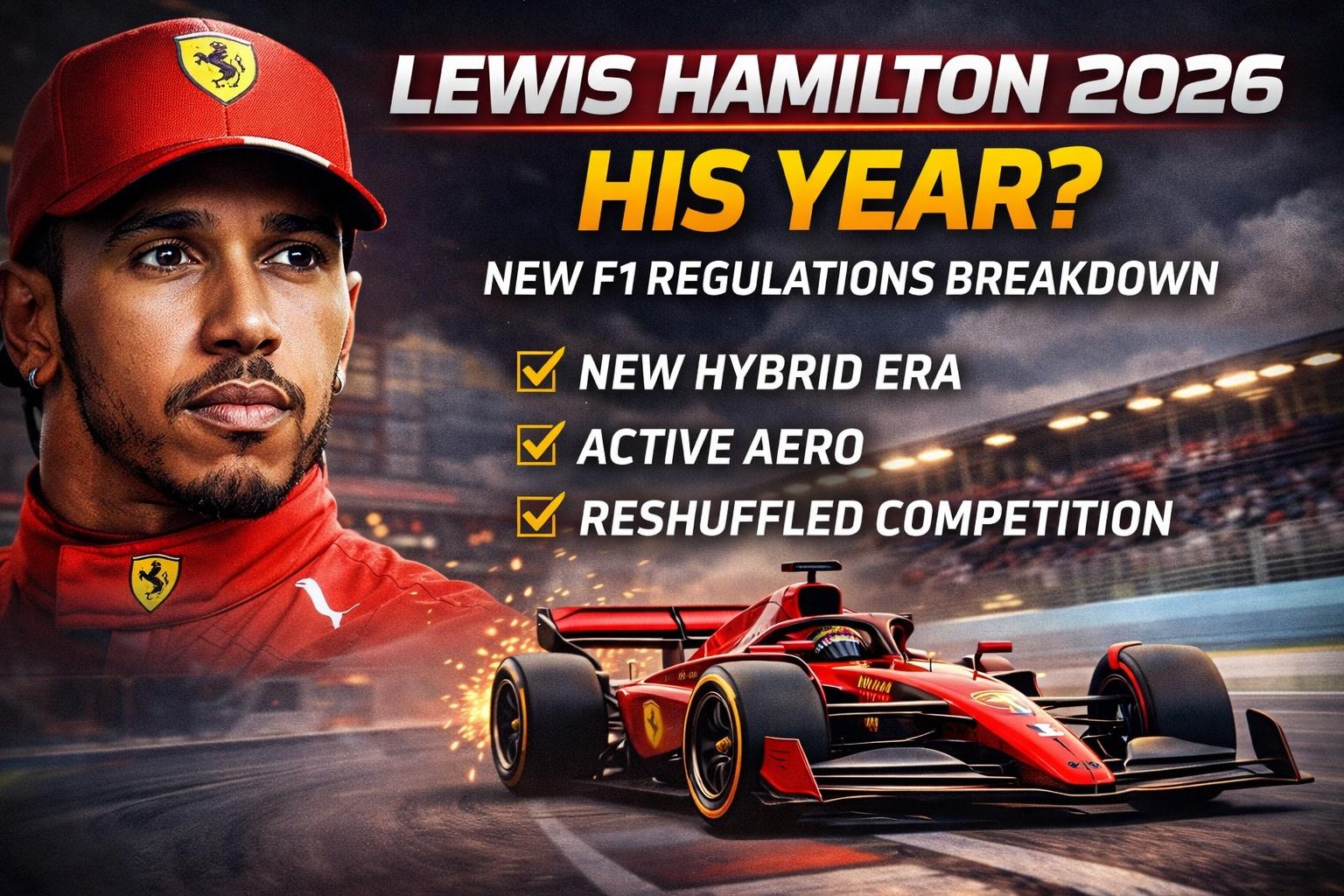
The 2026 Formula 1 season is not just another regulation tweak. It is a structural reset of the sport’s DNA.
New power units. Active aerodynamics. Sustainable fuels. A 50/50 electric-to-combustion energy split. Lighter cars. A different driving philosophy.
And in the middle of that shift stands Lewis Hamilton — a seven-time world champion whose career has repeatedly intersected with regulatory revolutions.
If history tells us anything, it’s this: Lewis Hamilton performs at his highest level when Formula 1 changes the rules.
2026 may not just be another season.
It may be the season that defines the final chapter of his legacy.
To assess why 2026 could favor Hamilton, you have to understand how dramatic this reset truly is.
The FIA’s 2026 regulations introduce:
This fundamentally alters car behavior. Energy deployment becomes central. Downforce philosophy shifts. Balance windows narrow. Drivers will manage battery release more aggressively throughout the lap.
Several current drivers have already voiced concerns about the driving feel under the new architecture. More electrical dependency means more energy management strategy. Less brute-force mechanical grip.
That kind of technical volatility historically disrupts the competitive order.
And when competitive order resets, experience becomes leverage.
Lewis Hamilton’s greatness is not rooted in dominance alone. It is rooted in adaptability.
Hamilton entered Formula 1 already operating at championship level. He won his first title in 2008 during a tightly contested era that demanded consistency and race intelligence.
When turbo-hybrid engines debuted, Mercedes-AMG Petronas Formula One Team mastered the technical shift. Hamilton did the rest. Six championships followed in the hybrid era.
He did not merely win — he defined the era.
The 2022 regulation overhaul temporarily destabilized Mercedes’ advantage. Hamilton adapted, delivered podium consistency, and provided developmental feedback that rebuilt competitiveness.
Each reset forced recalibration.
Each reset elevated his relevance.
2026 represents the largest recalibration since 2014.
The defining feature of 2026 will be energy deployment discipline.
Drivers will be managing:
Hamilton has consistently demonstrated elite tire preservation and energy conservation skills. His throttle modulation is among the smoothest on the grid. His corner exit management reduces degradation over stints.
In an era where aggression alone will not win races, smooth efficiency becomes weaponized.
Where some drivers rely heavily on high-downforce confidence and aggressive rotation, Hamilton thrives in rhythm-based driving.
That distinction matters when energy allocation defines overtaking opportunities.
If 2026 sees Hamilton in red — driving for Scuderia Ferrari — the narrative intensifies.
Ferrari historically thrives when it commits fully to regulation resets. The 2026 shift presents a rare window:
If Ferrari delivers a competitive baseline, Hamilton brings the operational edge.
Development feedback from a veteran of three regulation generations becomes invaluable during year-one instability.
The combination of historic brand and legacy driver creates a convergence moment rarely seen in modern Formula 1.
At this stage of his career, Hamilton is not racing for validation.
He is racing for finality.
An eighth world championship would:
There is a different level of mental clarity when pressure shifts from proving to solidifying.
Drivers often peak psychologically when legacy is within reach.
Hamilton has historically performed under maximum spotlight — not despite it.
The 2026 season will not be predictable.
New manufacturer dynamics include:
New entrants often create volatility. Volatility compresses margins.
Compressed margins elevate driver impact.
Hamilton’s influence inside development programs is well documented. His feedback sensitivity has shaped championship platforms before.
In chaotic transitions, driver technical literacy becomes decisive.
By 2026, Hamilton will be a veteran among a younger generation of aggressive drivers.
But Formula 1 has repeatedly shown that age is not a limiting factor when technical intelligence compensates for physical decline — if decline even exists.
Modern F1 conditioning, simulation work, and recovery science extend peak performance windows.
Experience in reading race evolution often outweighs youthful reflex advantage in energy-managed formats.
2026 will not reward pure instinct.
It will reward decision quality.
Hamilton remains elite in decision architecture.
Energy-heavy racing introduces chess-like dimensions:
Hamilton has historically operated two strategic layers ahead in long-run execution.
In a hybrid-dominant era, strategic patience compounds advantage.
Over one season, micro-decisions separate contenders from champions.
Few drivers manage micro-decisions as consistently as Hamilton.
Formula 1 operates in narrative waves.
Dominance phases transition. Heroes rise. Legends recalibrate.
The sport thrives on cyclical tension.
A 2026 Hamilton resurgence would represent:
It would not simply be another championship.
It would be structural dominance across eras.
Let’s assess the key alignment factors:
The alignment is not emotional.
It is architectural.
An eighth championship in 2026 would symbolize:
It would redefine statistical and contextual greatness simultaneously.
Few athletes in any sport achieve dominance across three technological epochs.
Hamilton is positioned to attempt exactly that.
Possibly.
Regulation resets create rare windows. If the car aligns competitively in 2026, the opportunity crystallizes immediately.
Delay reduces probability.
This urgency may intensify performance output.
Elite athletes perform differently when windows narrow.
The case is not built on nostalgia.
It is built on structural precedent.
Lewis Hamilton historically thrives when:
2026 checks every one of those boxes.
If the platform is competitive — whether engineered in Brackley or Maranello — Hamilton enters that season with:
And if everything converges correctly, 2026 will not be remembered as a transition year.
It will be remembered as the year Lewis Hamilton reclaimed Formula 1 on the sport’s most transformative stage.

