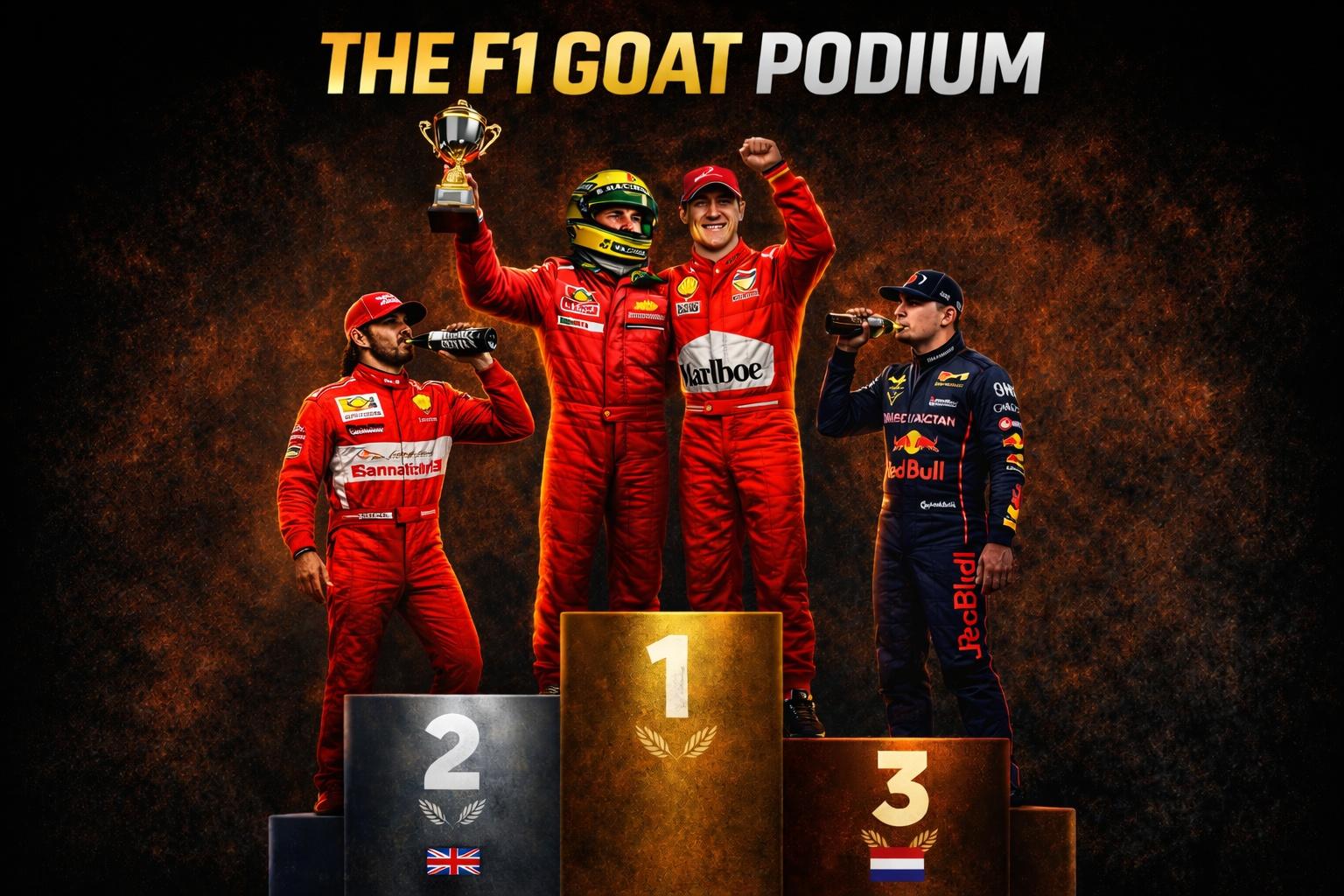
Hamilton vs Verstappen vs Senna vs Schumacher: The Ultimate GOAT Debate in Formula 1
The GOAT debate in Formula 1 is not a casual conversation anymore. It’s structural.
With Max Verstappen now a four-time consecutive World Champion (2021–2024), the discussion shifts from “future potential” to “historical positioning.” At the same time, Lewis Hamilton remains statistically unmatched across eras. Michael Schumacher still represents the architectural dynasty model. And Ayrton Senna remains the transcendental benchmark.
So who is the real GOAT of Formula 1?
The answer depends on how you define greatness.
This breakdown analyzes championships, era dominance, technical driving style, cultural impact, and historical consequence — then rebuilds the debate using a GOAT Pyramid model that reframes the conversation entirely.
Let’s begin with the obvious metric.
Hamilton’s longevity is elite. He won his first title in 2008 and continued winning deep into the hybrid era with Mercedes-AMG Petronas. Sustained dominance across 15+ seasons is rare.
Schumacher built Ferrari’s modern dynasty. His era was defined by team integration and relentless optimization.
Four straight championships removes the “small sample size” narrative. Sustained consecutive dominance places Verstappen among the elite tier historically.
On raw championship count alone, Senna sits behind the others.
But statistics are not the full story.
Each driver operated under radically different competitive conditions.
Senna raced in an era with:
He drove knowing the margin for error was terminal. That context changes the psychological calculus.
His death at the San Marino Grand Prix accelerated safety reforms that permanently reshaped F1’s structure.
That is legacy beyond trophies.
Schumacher’s Ferrari years represent one of the most complete system builds in motorsport history.
He:
His five consecutive titles cemented Ferrari dominance.
Schumacher’s greatness was constructed.
It was methodical.
It was systemic.
Hamilton’s strength is adaptability.
He won in:
He defeated multiple teammate archetypes — from Fernando Alonso to Nico Rosberg.
Hamilton also expanded F1’s cultural identity beyond racing. His influence touches fashion, activism, and global brand alignment.
His legacy extends outside the paddock.
Verstappen’s four consecutive titles represent concentrated era control.
His 2022–2024 seasons weren’t close contests. They were competitive suppression.
His car placement under braking, defensive positioning, and tire window extraction are technically elite.
Unlike Hamilton, Verstappen’s influence is performance-centric rather than cultural.
He represents pure racing absolutism.
Instead of ranking linearly, the GOAT Pyramid organizes greatness by dimension.
Michael Schumacher & Lewis Hamilton
Seven championships each.
Long-term dominance.
Statistical scale.
This is the structural base of modern F1 greatness.
Max Verstappen
Four consecutive championships.
If he reaches five or six, he ascends to the foundation tier.
Right now, he owns the most aggressive upward trajectory in modern F1.
Ayrton Senna
Three titles.
But unmatched peak intensity.
Qualifying dominance.
Wet-weather supremacy.
Structural safety impact.
National symbolism in Brazil.
Senna represents mythology — the emotional and historical benchmark.
Four titles is not casual territory.
Drivers who reached it:
Vettel’s dominance was regulation-dependent.
Prost’s was strategic and calculated.
Verstappen’s statistical margins in peak seasons exceed both in raw suppression metrics.
The next inflection point is five titles.
At five, Verstappen exits the Prost/Vettel comparison and enters Schumacher/Hamilton territory.
Each driver’s technical fingerprint defines their era.
Hamilton and Senna extend beyond racing most visibly.
Legacy depends on how careers conclude.
If Verstappen:
If Hamilton wins another championship — especially with Ferrari — his legacy strengthens further.
Senna’s apex position is less vulnerable because it’s rooted in consequence, not count.
There is no single correct answer — only dimensional dominance.
If you value:
Right now:
Hamilton holds the broadest historical resume.
Schumacher remains the dynasty architect.
Verstappen is building real-time dominance.
Senna remains the emotional and structural reference point.
The GOAT debate is not finished.
It is still unfolding — race by race.

