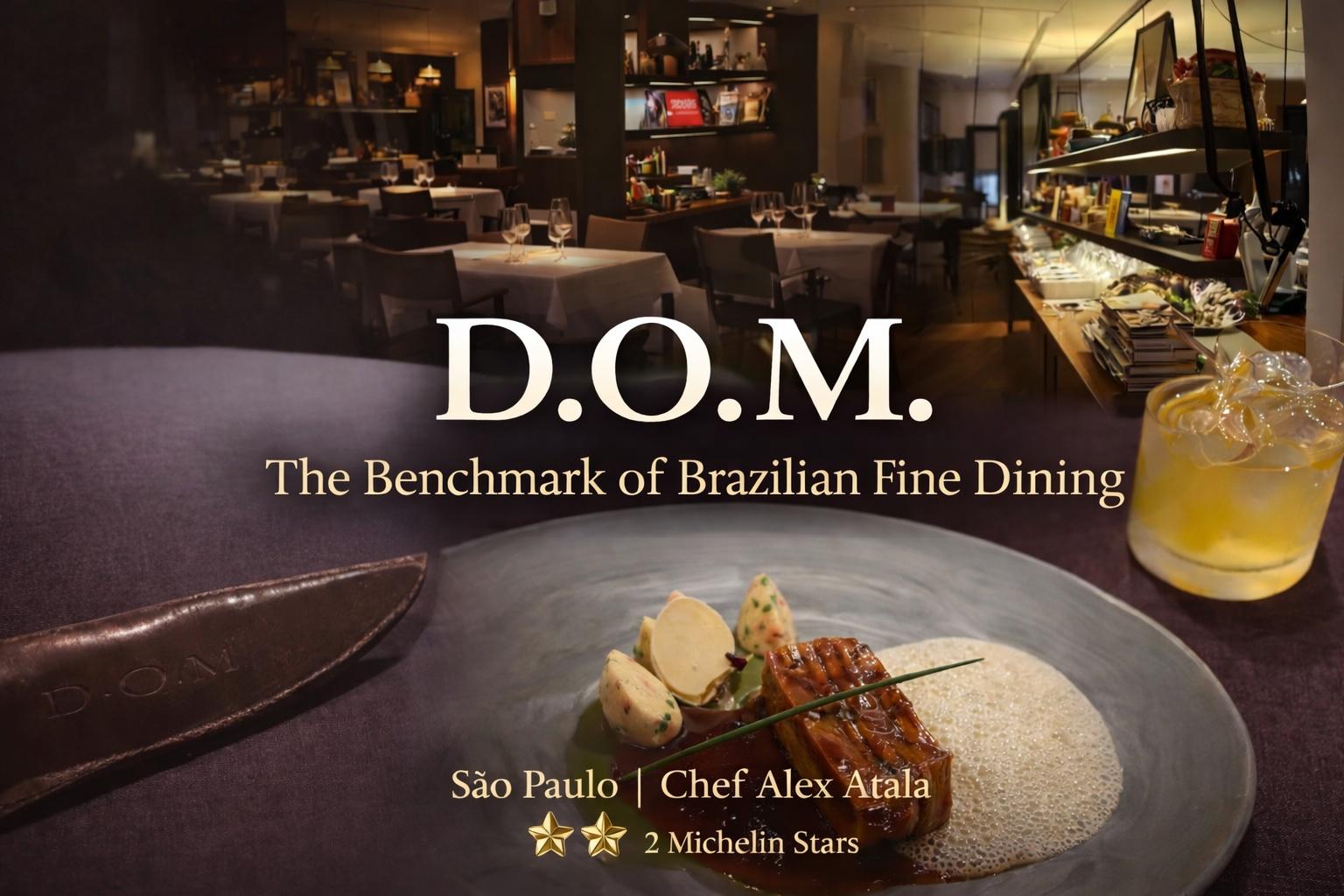
When I first started dining seriously in São Paulo, I didn’t book D.O.M.
I chose Evvai. Then Tuju.
Both are exceptional. Both are Michelin-starred. Both represent modern Brazilian gastronomy at a high level.
But skipping D.O.M. initially was an error.
Because D.O.M. is not simply another great restaurant in São Paulo. It is the foundation that allowed Brazil — and arguably much of South America — to be taken seriously on the global fine dining stage.
If you want to understand the structure of Brazilian haute cuisine, you start here.
Before Michelin stars and global recognition, Alex Atala was a punk DJ. That detail isn’t trivial — it explains the edge.
He trained in Europe, absorbed classical technique, but chose not to replicate European fine dining in Brazil. Instead, he elevated Brazilian biodiversity itself.
He made Amazonian ingredients luxury.
At a time when Brazilian cuisine was internationally reduced to churrasco and beach culture, Atala presented tasting menus built around tucupi, jambu, pirarucu, and other Amazonian elements with Michelin-level precision.
That decision shifted perception permanently.
D.O.M. holds two Michelin stars in São Paulo — a serious distinction in a city where the Michelin footprint is selective.
It has also ranked on The World's 50 Best Restaurants, at one point entering the global Top 10.
That matters.
Because it wasn’t simply about awards. It was about validation that Brazilian cuisine could operate at the same technical and conceptual level as Paris, Tokyo, or Copenhagen.
D.O.M. didn’t borrow legitimacy.
It established its own.
The defining contribution of D.O.M. is sourcing.
Atala built relationships with Amazonian producers and indigenous communities long before “hyper-local” became a global trend. He treated the rainforest as a refined supply chain, not an aesthetic backdrop.
Signature ingredients introduced into fine dining conversations include:
These were not shock-value inclusions. They were integrated into disciplined, structured tasting menus.
Brazil was no longer derivative. It became originative.
What surprised me most wasn’t just the food. It was the service precision.
They changed my tablecloth four times.
Not once. Four times.
Different textures, different fabrics, depending on the progression of the meal.
Each course arrived with its own silverware. Not generic fine-dining repetition — specific utensils calibrated to the dish.
At one point, I was handed a hunting knife to cut a course.
That detail matters.
It wasn’t gimmicky. It reinforced the narrative of the ingredient — primal, Brazilian, intentional. The tool matched the story.
This is where D.O.M. distinguishes itself from restaurants that rely purely on plating aesthetics. The entire environment shifts with the course progression.
The choreography is subtle but exacting.
For diners who understand service architecture, that level of refinement signals serious intent.
To understand D.O.M.’s position, you have to compare it to Lima’s culinary ascent.
Restaurants like Central and Maido built tasting menus around ecosystems — altitude, coast, jungle.
Peru deserves its recognition.
But D.O.M. was one of the first South American restaurants to prove biodiversity-driven cuisine could hold Michelin-level structure internationally.
Brazil’s moment did not follow Peru. It developed parallel — and arguably earlier in terms of global fine-dining legitimacy.
Atala demonstrated that:
That influence reverberates across the continent.
When I experienced Evvai, I saw innovation layered onto heritage.
When I dined at Tuju, I experienced hyper-modern Brazilian technique.
But D.O.M. contextualizes both.
It is not the most playful.
It is not the most experimental in presentation.
It is the benchmark.
Without D.O.M., the ecosystem evolves differently.
It established that Brazilian ingredients could carry Michelin-level narrative weight.
Everything else builds from that confidence.
The dining room is restrained.
Dark woods. Controlled lighting. Minimalist settings.
No excessive theatrics.
But within that restraint is constant recalibration — linens changed, utensils swapped, pacing controlled.
It is quiet authority.
For serious culinary travelers, especially those building structured São Paulo itineraries around Michelin dining and Formula 1 weekends, this type of restaurant anchors credibility.
Atala’s advocacy for Amazon preservation and responsible sourcing is integrated into operations, not layered on top as marketing language.
Producer relationships matter. Biodiversity matters.
The restaurant’s philosophy is tied directly to ecological and cultural preservation.
That depth reinforces its legitimacy.
I regret not booking D.O.M. first.
Not because Evvai or Tuju underdelivered. They didn’t.
But D.O.M. sets the calibration point.
Once you experience it — the ingredient narrative, the precision service, the tablecloth changes, the hunting knife — you understand the framework.
It establishes context for everything else.
Foundation matters.
D.O.M. is not chasing trends.
It established Brazil’s position in global fine dining.
Chef Alex Atala elevated Amazonian biodiversity to Michelin-level discipline and forced the world to recognize Brazilian gastronomy as elite.
For serious culinary travelers — particularly those evaluating South America’s most important restaurants — D.O.M. is not optional.
It is the benchmark.

