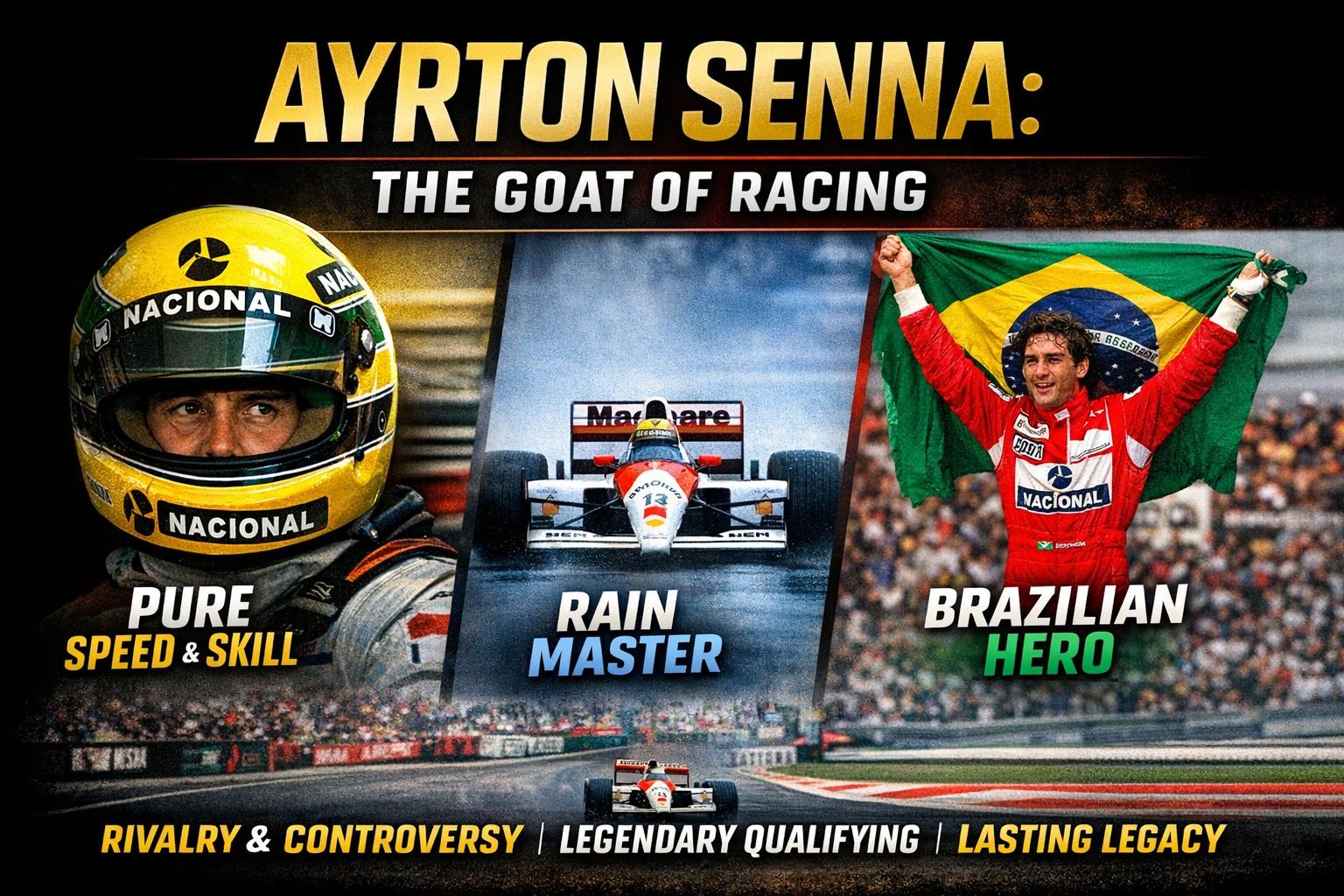
A Deeper Comparative and Technical Analysis
There are champions.
There are legends.
And then there is Ayrton Senna.
When people debate the “Greatest of All Time” in Formula 1, the discussion usually collapses into numbers: championships, wins, poles, longevity. By that metric, you can argue for Michael Schumacher or Lewis Hamilton.
But racing is not baseball. It is not basketball. It is not purely statistical.
Formula 1 is contextual. It is mechanical. It is political. It is psychological. And in Senna’s case, it was existential.
This is why, after deeper analysis—technical, historical, and cultural—I still consider him the GOAT.
To understand Senna, you must first understand Alain Prost.
Prost was calculating. Strategic. Economical. He managed races like a chess grandmaster. Tire wear, fuel load, championship math—he mastered it.
Senna was different.
He didn’t manage races. He attacked them.
Prost would settle for second if it preserved the title. Senna would risk everything for the win.
The 1988 season at McLaren is the most clinical example. The MP4/4 was dominant. But Senna out-qualified Prost 13–2. That’s not marginal superiority. That’s raw pace.
Monaco 1988 remains one of the greatest qualifying laps in history. Senna outpaced Prost by 1.4 seconds in identical machinery. At Monaco. That margin borders on absurd at that level.
He later described entering a state where he was driving beyond conscious control.
That’s not marketing mythology. That’s flow state at the edge of mechanical failure.
Senna’s driving style was unconventional for his era.
In turbocharged cars—especially mid-80s machines with brutal power delivery—throttle control was everything. Turbo lag meant the power came like a hammer.
Senna used micro-corrections in throttle input to balance the rear. He drove with a level of sensitivity that allowed him to rotate the car mid-corner in conditions others could not manage.
He favored a sharp front end. This made the car more nervous but allowed earlier turn-in and tighter lines. Drivers who prefer stability would struggle with that setup.
Senna preferred responsiveness over comfort.
That preference explains his dominance in wet conditions.
Donington 1993. Opening lap. Fifth to first in one lap.
That wasn’t luck. It was anticipation. Senna searched for grip where others hesitated.
In low-visibility, low-grip conditions, car control becomes art. That’s where Senna separated himself.
He didn’t survive the rain. He weaponized it.
Michael Schumacher redefined professionalism in Formula 1.
He built teams around himself. He brought fitness standards into the modern era. He engineered dynasties with Ferrari.
Statistically, Schumacher surpassed Senna:
But Schumacher operated in a more structured era. Safety standards had improved post-1994. Team infrastructure evolved. Simulation and telemetry matured.
Schumacher was a systems driver. He optimized the machine.
Senna was a transcendental driver. He elevated it.
The difference is subtle but meaningful.
Schumacher’s greatness was constructed.
Senna’s felt innate.
Lewis Hamilton represents modern excellence.
Seven titles. Over 100 wins. Cultural influence beyond motorsport. Adaptability across eras—from V8s to hybrid turbo power units.
Hamilton’s longevity is unmatched.
But Senna’s peak intensity was unmatched.
Hamilton operates in a hyper-optimized, data-rich environment. Driver coaching, simulators, engineering feedback loops—all are vastly advanced compared to the late 80s and early 90s.
Senna drove in an era where mistakes were fatal.
That reality alters the psychological equation.
Modern drivers risk injury.
Senna risked death.
When evaluating GOAT status, that context matters.
Brazilian Grand Prix, 1991.
São Paulo. Interlagos.
Senna had never won at home. Mechanical failure loomed. The gearbox began to fail late in the race. He was stuck in sixth gear.
Driving one-handed. Muscles cramping. Physical pain escalating.
He finished anyway.
When he crossed the line, he could barely lift the trophy.
That moment transcended sport.
Brazil in the late 80s and early 90s was navigating economic instability and political transition. Senna became a symbol of excellence on the global stage.
He wasn’t just a driver. He was national validation.
You still feel that in São Paulo. Interlagos carries his presence in a way few circuits carry a driver’s memory.
San Marino Grand Prix, May 1, 1994.
The tragedy reshaped Formula 1 permanently.
Post-1994 reforms accelerated:
No single driver’s death had such structural consequences.
Senna’s loss forced the FIA and teams to confront vulnerability.
His impact didn’t end at the apex of Tamburello. It reshaped the architecture of modern F1 safety.
The Instituto Ayrton Senna continues educational initiatives across Brazil, impacting millions of children.
This is critical.
Greatness is not isolated to lap times. It’s measured in sustained influence.
Schumacher built Ferrari dominance.
Hamilton shaped diversity conversations.
Senna inspired a nation—and continues to invest in it posthumously.
Let’s be clear:
If championships alone defined greatness, the debate ends.
But Senna’s era featured:
Championship counts in that era were more volatile.
His 65 pole positions at the time of his death were record-setting. That statistic reveals pure pace.
Pole positions isolate performance. They remove race strategy variables. Senna’s qualifying dominance supports the argument for peak superiority.
Senna operated at an edge that bordered on obsession.
He demanded perfection—from himself and others. He was polarizing. Intense. Uncompromising.
Some critics call that recklessness.
I see it as intolerance for mediocrity.
Elite performers often operate with uncomfortable intensity. Senna did not dilute himself for palatability.
GOAT conversations often avoid this element.
But edge matters.
I respect standards.
Senna’s refusal to compromise performance resonates beyond racing.
In hospitality.
In business.
In curation.
In execution.
Details separate premium from average.
Senna obsessed over details.
He didn’t race to participate. He raced to dominate.
That mindset translates.
You either commit fully or you accept second-tier outcomes.
He never accepted second-tier outcomes.
If the GOAT is defined strictly by:
Then Schumacher and Hamilton have superior resumes.
If the GOAT is defined by:
Then Ayrton Senna remains unmatched.
He was not statistically invincible.
He was not universally diplomatic.
He was not cautious.
He was absolute.
And greatness in motorsport has rarely been cautious.
Ayrton Senna did not simply win races. He defined what uncompromising excellence looked like in a sport where the margin between heroism and catastrophe was millimeters.
His legacy still shapes:
That is not nostalgia.
That is structural influence.
For those reasons—and after comparing eras, styles, and impact—I consider him the GOAT of racing.
Not because of numbers.
Because of consequence.

